|
|

 |
 |
 |
 |
 |
 |
 |
 |
 |
| Mon., June 8, 2026 |
 |
| Moon Phase: Last Quarter |
|
Next Full: June 29 Next New: June 14 Sunrise: 5:26 a.m. Sunset: 8:24 p.m. |
| More Info |
| First Up New York's blackfish season, the first fall fishery to kick off, opens October 1. By Capt. Rob Skonieczny, Outcast Fishing Charters, Tottenville, Staten Island Originally Posted 9/26/08 |
||
|
Every year during blackfish season my brother Joe and I get supercharged. It is one great feeling for us. Seeing our customers swing blackfish over the rail is what it’s all about. It’s also about teamwork between my brother, me and the mate to help our customers from the time they step on the boat to the time they leave. Everyone leaves with a great experience from setting the anchor right through to setting the hook in the fish’s mouth. Some of the anglers with less But the thing about blackfish is that Little changes can really make a difference. But that’s why everybody likes it. The challenge. Several things can matter: patience on the bite; the bait; whether to use monofilament or braided line; and the size of the weight on the rig. Patience on the bite is a well-known factor. A premature swing usually leads to a miss. A lot of times light bites are felt at first, because the fish just picks at the bait, not going in for the kill. They’re curious. You’ve got to wait until the bait is back in the molars, and the blackfish is crunching. If you swing too soon, you’ll either miss, come up with a small fish like a bergall or foul hook a fish. The bite’s not always like that, but 99 percent of the time it is. |
|
We tell our customers to wait to feel the fish jump all over the bait three or four times consistently until setting the hook. Blackfish will like one bait over another, and something completely different another time.
We’ll bring green crabs, white or stone crabs, calico crabs and hermit crabs. Calicoes are mostly around in spring, and they’ll disappear in October. We’ll have the anglers mix up the baits, so some use one type of crab, others use another, or some use half, and so on, and see what works. Blackfish are so picky that they even dislike an old, dirty crab. We’ll smell the bait and see if it smells sweet. They like that. The type of line to use depends either on conditions or the way the blacks are biting. In 100 feet of water, with Even the weight used can make a difference that’s suprising. When the bite is shy, the difference between something like switching to 10 ounces instead of 12 can be amazing. But during other times the blackfish want the resistance, are aggressive and like to pounce on the bait. So a heavier weight will be better. All of these factors can seem small, but with blackfishing, the little things can really matter. But that’s what makes it fun. Putting great smiles together with our customers while blackfishing is what it’s all about. |
||
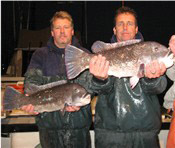
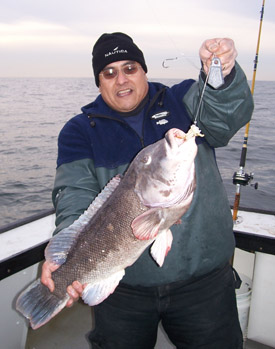 They’ll even like a specific bait fished a certain way over another, like a whole crab, half crab, all the legs off, all the legs on, a few of the legs on, a half crab with no legs, and so on.
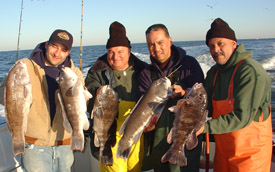 If currents aren’t strong, sometimes monofilament will work better. Sometimes the fishing demands the most give in the line, because the blackfish shy away from all the tension. The stretch of monofilament can help.
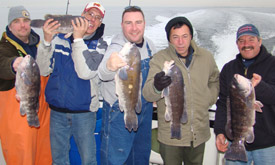 currents create too much “noise” through monofilament, and blackfish won’t touch a bait unless it’s on braid.