|
|

 |
 |
 |
 |
 |
 |
 |
 |
 |
| Mon., June 8, 2026 |
 |
| Moon Phase: Last Quarter |
|
Next Full: June 29 Next New: June 14 Sunrise: 5:26 a.m. Sunset: 8:24 p.m. |
| More Info |
Get It While It's Hot |
||
|
Some things are better
when Eating dinner while it’s warm, Retiring old enough to have saved money but young enough to enjoy. Barnegat Bay fluke fishing in The flatbacks scurry along the bay from spring through fall, all fishing-season long. But from the opening of fluke season tomorrow through the next month or so is the best time to focus on them there, said Capt. John Hobson from Perfect Drift Sport Fishing from Waretown. The flatties can cover broad areas of the bottom like shingles on a roof during those weeks. But by about the Fourth of July, the majority of the fish will escape the warming bay waters and move to the ocean. Afterward they’ll hold in small pockets of the bay, giving up a catch or two while anglers target other suspects, like weakfish. A bonus, The time to specifically chase them on Barnegat Bay, a rich habitat attracting lots of the fish a moment mostly in spring, is now. Don’t delay for the best catches. Perfect Drift certainly won’t. During the first days of the season, Capt. John will search for the bottom huggers in the relatively shallow waters of the bay, with the warmest temps. |
|
The edges of sandbars, the edges of flats that drop off to deeper holes and other typical structure are the places to find them then. Perfect Drift fishes for the bay’s fluke along a 5-mile stretch from Forked River to Barnegat. But that’s only because those waters are closest to the boat’s port, and as many fluke swim there as anywhere in the bay, so there’s no reason to leave. Other parts of the bay also attract the flatfish. As the waters warm, the boat’s fluke charters will start fishing the edges of the deeper, cooler holes in the bay, including the Intracoastal Waterway, the deepest spot. The fish in the bay are spread all over, and John searches for them, and if one or two are caught, he’ll drift the area again, maybe moving a little to the right the next time, or somewhat to the left the next, or maybe a bit ahead of the original spot the next, and so on.
Drifting is always the way to go, because flattie anglers should cover lots of waters and find the fish, then go back and find more where those came from. Where there’s one, there’s usually more. This isn’t a matter of sitting and waiting for the fish to come to you, like fishing for some species. You’ve got to go to them, because they’re mostly parked at one spot, not moving far. Area’s including Oyster and Double Creek channels are also popular, but boat traffic there can become heavy, especially on weekends, getting in the way of drifts. Then John will move off to broader areas, and less popular ones, like Tice’s Shoal. Plenty of less popular areas are around. John’s anglers fish the full gamut of fluke baits, including squid, minnows, spearing, mackerel strips, fluke belly strips, bluefish belly strips, weakfish belly stripers and Berkley Gulps. Sometimes they’ll combine the baits, like a squid and spearing combo or a squid and minnow combo, or sometimes they’ll fish them alone, and see what works. The bait can also depend on what worked on the last trips. The belly strips are used because they’re effective, but also because the bellies are usually trimmed off fish fillets at the end of a trip and discarded. Nobody usually eats them. But John will cut the bellies into a few strips and freeze them for bait for the next trip. His anglers mostly fluke fish with lightweight bucktails, 3/8- or 1/4-ouncers, or even large shad darts. The light bucktails are used because the bay is shallow and also because large bucktails act like a vacuum cleaner for grass and other debris. Bucktails can also attract other fish, including blues and weaks, that are always possible to catch along with the flounder. The baits will be impaled on the bucktails. The anglers will toss out the bucktails and hop them gently along the bottom. Or sometimes they’ll just let them drift. Both methods work. But sometimes Perfect Drift’s charters will also fish a fluke rig, simply either a fish-finder or a three-way swivel with a single hook on a 36-inch leader. John mostly prefers a plain hook with no bells or whistles like spinners. He believes the fish mostly prefer the bait more than the gimmicks, and that the spinners and such attract anglers more than fish.
A rod rigged with a Light, medium action spinning and conventional rods 7 feet long are John’s preference for fluking the bay. Spinning rods will be used with bucktails, easier to cast them and work the area. Conventional rods will be used with the rigs, easier to pay out line. John prefers to fish during the two hours before and after either low or high tides, so long as the water’s moving. The current then is flowing but not too quickly, and those tides just always seem to produce. Every location has its allure for fishing. Some are known for tons of fish, a variety of fish, or big fish and so on. Or maybe some offer quick access to the ocean, or the option of fishing a bay or a river, or something else The thing John likes most about the Barnegat Bay area is that it offers lots of options. If the fish are biting in the bay, anglers will fish there. If the bay’s not panning out on a given day, they can quickly hop to the ocean. If fishing the ocean was the plan but seas turn out rough, anglers can fall back on the bay. If one species isn’t biting, like fluke, stripers or weakfish, maybe another is a better choice that day. But from now through the Fourth of July, one choice is clear: fluke fishing will be best, prime time, in the bay. The bay will be cool enough, but not too cold, to attract most of the fluke in the area. But by no means will the fishing be cool. Get it while it’s hot. |
||
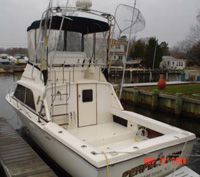
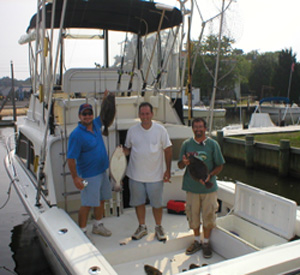 Sometimes Perfect Drift will fish the mainland side of the bay, sometimes the ocean side, and that’s only because of how winds and currents create the drift--the Perfect Drift!—that’s necessary for fluke fishing.
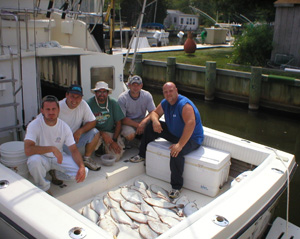 But he’ll sometimes throw a single, colored bead, a simple bucktail skirt or an Octopus in front of the hook.