KayakFishingStuff.com
We have the largest selection of fishing kayaks in the world! Stop by in person or visit us online.
We ship kayaks anywhere in the continental U.S. and accessories worldwide.
Kayak fishing is our business and our obsession. Call us and we’ll make sure you get the right gear the first time.
Kayak Fishing Stuff
3 Iron Mountain Road
Mine Hill, NJ 07803
973-659-1114
866-YAK-4-LESS
Visit Web Site
|
|
The following article is a
condensed version of an article
from KayakFishingStuff.com.
Once you start checking into
kayaks for fishing, you’ll learn
there are basically two types:
The Sit In Kayak (SIK) and
the Sit On Top (SOT).
Each is available in models that either fish well or don’t.
The SIK, the Sit In Kayak, is the traditional style that usually comes to mind when people envision a kayak.
The occupant sits inside, and a skirt usually goes around the waist, sealing the inside from the elements.
Without a skirt, the kayak becomes only a fair-weather craft, because any water entering becomes trapped and has to be physically removed.
This is accomplished while out on the water by the use of a sponge for small amounts or a pump.
SIKs make up the majority of kayaks purchased around the world. They’re used for touring, white water and general recreation.
|
The SOT, the Sit On Top, is the new breed, and is essentially a glorified surfboard.
Rather than sitting in the kayak, you sit on it. The kayak is a hollow tube with scuppers, allowing water to drain. No need for sponges or pumps, because the vessel is self-bailing.
SOTs were created as recreational kayaks, originally used at warm-water resorts as play vessels. They’re popularity increased each year. Besides resort use, they’re now also used for fishing, kayak surfing and general recreation.
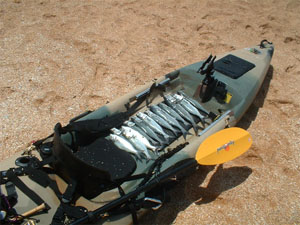 SOTs are the reason kayak fishing is growing. When the first kayak anglers, southern Californians, started flirting with the sport back in the 1980s, they initially used surfboards, paddling out beyond the breakers with a fishing rod and some gear. SOTs are the reason kayak fishing is growing. When the first kayak anglers, southern Californians, started flirting with the sport back in the 1980s, they initially used surfboards, paddling out beyond the breakers with a fishing rod and some gear.
They couldn’t take much on a surfboard, and started investigating something better.
The Sit on Top is what they came up with.
The ability of SOTs to transport the angler and gear to the ocean is why the sport took off. Even though the SIKs have been around a long time, the SOTs are responsible for the sport as we know it now.
When we hear from customers considering the sport, they’re usually looking at an SIK, because they want to be protected from the elements.
This is a flawed view of kayak fishing, and shows that they really haven’t considered the sport as it’s practiced.
Kayak fishing is a water sport. If you don’t want to deal with water, either stay on land or get a boat.
A kayak is not a boat, so don’t think of it as one. It is one of the most versatile vessels you’ll ever use, and it’ll allow you to access all kinds of places that hold fish.
The majority of anglers who purchase a kayak for fishing do so because they want to catch fish, and sometimes the best place to catch fish isn’t while sitting in the kayak.
Flats Fishing: One of the best things about a kayak is the access to shallow flats that it provides. There are lots of these types of environments, especially on the Atlantic and Gulf coasts.
Imagine that you’re fishing a flat and you’d like to get out and wade fish. There are a few reasons you might want to do this.
- You’ve been sitting for a while in the kayak, and it’s nice to get out to both walk and stretch. It’s a good idea to take every opportunity you can to get out of the kayak. It greatly prolongs the amount of time you can spend fishing, as sitting in a kayak all day gets old and tiring. Your legs and back will thank you for it.
- There’s a breeze or winds, requiring you to use the paddle to control, stabilize and positioning the kayak, and you can’t cast and work the paddle at the same time. So hopping out eliminates the need to constantly adjust the kayak.
- By standing, you’re higher up than sitting in the kayak. The higher you are on a flat, the more you’re going to see. This is a big advantage in fishing the flat.
So you’ve decided to get out of the kayak. Getting back in the kayak can be challenging.
There’s a good chance that when you decide to get back into the kayak the water could be 3 feet deep. In an SOT you sit on rather than in the kayak, so getting in and out is actually getting on and off. It’s easy to do.
Conversely in an SIK, it isn’t so simple, and your chances of capsizing the kayak are much greater, and it’s also much more difficult to do. Even a fairly athletic person wouldn’t want get back into an SIK in 3 feet of water.
Now imagine that you’re wearing waders, which you might do if the water is cold. That raises the degree of difficulty.
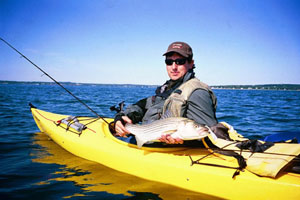 Accessing the Ocean: When you fish the open ocean, you’re going to get there via an inlet or the surf. Sometimes the surf is so calm that you’d think you were at a lake, but that’s unusual. So you need to be prepared for waves. Accessing the Ocean: When you fish the open ocean, you’re going to get there via an inlet or the surf. Sometimes the surf is so calm that you’d think you were at a lake, but that’s unusual. So you need to be prepared for waves.
As you paddle through the surf a wave might break over the kayak. When a wave comes over the bow of a Sit On Top, the cockpit briefly fills with water, but then it drains. It happens quickly, and by the time you’re beyond the surf, the water that came into the cockpit is gone.
Once beyond the surf, you retrieve whatever gear you’ve stashed below, and you’re ready to fish.
Having the ability to store gear away from the elements below deck is invaluable in keeping items protected. Should a wave knock you off an SOT, you’re just off, and your gear is where you left it. You simply go retrieve the kayak.
On a Sit In Kayak, you need a skirt to go through even moderate surf. Otherwise, should a wave come over the bow, it’ll fill with water, and doesn’t have the ability to drain.
Once beyond the waves, you have to remove the water from the kayak. This requires pumping.
Should you misjudge a wave, it could flip the kayak. The best thing that can happen is that you and the kayak part company. If this happens, the skirt gets pulled away. It would be impossible for the kayak not to fill up.
So figure that the kayak will fill with water if you have a mishap.
Many SIK models don’t have bulkheads. In other words, all the gear is now exposed to the water. Any gear that was in the cockpit is either floating around in the surf or is on the bottom.
Should you flip in an SIK, none of the consequences are good. In the very least you'll have a kayak full of water, and in the worst, you'll be upside down and still in the yak with your gear, bouncing around in the surf.
When an SIK flips the popular wisdom is to do an Eskimo roll. That’s okay if you’re in calm waters with a narrow kayak, but most SIKs used for fishing are often wider and don’t roll under ideal conditions, and the surf is as far from ideal as you’re going to get.
We don’t know about you, but we’d rather not be in such a situation.
Shallow Rivers: A kayak will take you into so many environments that are difficult if not impossible to reach via any other means. A shallow river is just such a place. Sometimes you can paddle, and at times you’ll need to drag the kayak up, around or between objects. These obstacles can be rapids, waterfalls, trees, log jams and all sorts of things.
Often you’ll find that you’ll be getting in and out of the kayak a lot. It’s much easier to get off a kayak rather than out of one if you’re doing it on a regular basis.
In some situations it will be like our flats scenario, and you’ll need to get on or off in a couple feet of water or more.
The more you find yourself leaving the kayak, the more you’ll appreciative an SOT.
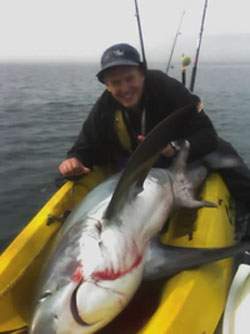 Keeping Fish: If you like to take fish home, then you need a place to keep your catch. If the fish are smaller fish, this isn’t a big deal. But if the fish are big, it is. Keeping Fish: If you like to take fish home, then you need a place to keep your catch. If the fish are smaller fish, this isn’t a big deal. But if the fish are big, it is.
In a Sit In Kayak, fish are kept either in the cockpit or on a stringer. A stringer is okay in freshwater , where you don’t need to travel far. A stringer full of fish provides drag, and isn’t good if you need to cover distance.
In some places a stringer can also attract predators. In the south, you have to be concerned about alligators, and in the salt, sharks. Neither is a good way to encounter these animals.
A tank well is a great place to keep fish. You can either place a cooler in the tank or simply put the fish in it and cover them with a wet burlap sack. Many Sit On Tops come with tank wells.
Another place to keep your catch is inside the kayak. The water is generally cooler than the air temperature, and under these circumstances provides a cooling effect.
A soft cooler is a great way to go, as it can conform to the space you have and with the addition of a few cool packs works extremely well inside the hull. Obviously the larger the hatch the easier it’s going to be to put a cooler inside the kayak.
Hatches vary significantly from kayak to kayak. Some are enormous, while others are so small that they’re impractical.
Comfort: A Sit In Kayak is an enclosed vessel, so your freedom of movement is restricted. Your legs are stuck, and you don’t have much choice about where you can put them.
Because you sit on a Sit On Top, it’s easy to change positions. You can sit side-saddle, putting your legs over the side.
In hot weather, the SIK can really heat up. With an SOT, it’s easy to dip your feet in the water, and on a hot day, it feels fantastic.
SIKs come with a fixed seat. Some are very comfortable, but some are awful.
With few exceptions, SOTs utilize after-market seats. These seats run the full gambit from basic to incredibly posh and comfortable. Some models even have pump-up lumbar supports.
Both types of kayaks will enable you to catch fish.
An SIK is like only fishing with top-water lures or using a floating fly line. You will catch fish, but oftentimes there’ll be the need to go deep to catch.
Sit On Tops allow you to fish all environments.
The greater the versatility, the more fish you’ll catch. |