|
|

 |
 |
 |
 |
 |
 |
 |
 |
 |
| Mon., June 8, 2026 |
 |
| Moon Phase: Last Quarter |
|
Next Full: June 29 Next New: June 14 Sunrise: 5:26 a.m. Sunset: 8:24 p.m. |
| More Info |
Running and Gunning |
||
|
What did running and gunning originally mean, anyway? Basketball first coined the term to describe fast-paced hoops, freewheeling b-ball that emerged in the ‘70s, replacing set plays, giving the offense momentum. Run, duck, dive down the court. Gun, fire or shoot to score. Quick, exciting, effective. So is running and gunning down the beaches to score striped bass and blues. In New Jersey saltwater fishing, running and gunning needs no clarification. It usually means one thing. Running the boat along the ocean beaches to find schools of stripers and blues, then gunning the engine to meet them head on, casting jigs to the fray. “It’s one of my favorite types of fishing in spring,” said Capt. Anthony Reina from Angela Rose Charters, Point Pleasant. “The run and gun.” Striped bass and blues usually school the local ocean front from mid May through June or so. The fishing certainly is that: action. Fast, quick-paced, on the offense, unlike like anchoring and fishing with bait. Anthony’s trips will break Manasquan Inlet and run along the coast, anywhere from Long Beach Island in the south to the Shrewsbury Rocks up north, close to shore. He’ll keep an eye peeled for birds working the waters, eating bait that’s getting pushed to the surface from blues and striped bass feeding on them underneath. Blues swim toward the surface, and stripers hug the bottom, although small stripers can also hold toward the surface. Most schools carry both blues and bass that feed on bunker or smaller baitfish. When diving birds are spotted, Anthony guns to the area and sets up a drift that meets the school, without spooking the fish. |
|
The anglers cast metal jigs like diamond jigs, Ava jigs, Krocodiles or Red Devil Spoons, all imitations of baitfish. His biggest decision is whether to take a left to the north or a right to the south out of the inlet. During the season, he’s usually in tune with where the fish have been and where they’re headed, so he’ll cruise in that direction, often where his trips connected in the past days. But he’ll also keep in tune with the grapevine of other anglers or with fishing reports on the Internet for the latest on the whereabouts of most of the schools. Like if the fish are generally known to be north, he’ll run there.
Mornings offer some of the best fishing, typical in the sport, but also because of calmer seas with lighter, west winds that are prevalent. Stronger winds and southern breezes that pick up seas can increase by the afternoons. Late in the day or toward dusk can also offer a better bite, like in most fishing. The boat will be run to the school and set up on the drift in an attempt to place the vessel on the path that the fish will intersect. After the first couple of drifts, the direction the school is heading will be certain, and the boater will keep circling around ahead of the school and setting up the next drift, so the school of fish comes around and underneath the boat, without the boat motoring through the school and scaring it off. The anglers will cast, and on the Angela Rose, some will usually toss the long, diamond-shaped jigs like Ava’s and crank them in toward the surface. Others will usually drop down the spoon-shaped jigs like Krocodiles to the bottom, reel up five or six times, and repeat. They’ll all find out what works best. The anglers will also experiment with depths to find the zone for the best action. The fish on the bottom are usually anywhere from close to the bottom to 25 percent up. Anthony will also look at his fish finder and tell the anglers where the fish are holding.
The stripers in spring can usually weigh up to 20 or 25 pounds and are larger compared with fall, when the fish also migrate along the coast. The reason for the difference in sizes is unknown. But bass to 40 pounds can also be walloped in spring. The blues can typically weigh up to 10 pounds in spring and are bigger during the fall, again for unknown reasons. The same sizes of fish are usually found along the entire stretch of coast at a given time. A pod here or there might be a different size, but not usually. Rigging the jigs is simple. The jigs are tied to a 3-foot monofilament leader, usually 30 pounds, depending on the sizes of the fish, and sometimes 40 to 60 pounds, if big ones are around. Fluorocarbon leaders are unnecessary. The leaders are attached to the line with a swivel. That’s all. Wire leaders can be necessary to avoid bite-offs from blues, though stripers can shun wire, so fishing only with monofilament is ideal. But if bite-offs become inevitable, there’s no choice. If the blues are bigger, Anthony uses a 7- or 8-inch wire leader, nothing fancy, just a leader bought at the store. If the blues are smaller, he’ll tie on a shorter, store-bought wire. He usually uses 30-pound monofilament line on the reel for charters. When he’s fishing by himself, he prefers braided line, but fishing with braid becomes more complicated, and the tackle used with braid is more expensive, so monofilament is practical on charters. Braid is sensitive. There’s no stretch, and every bounce of the rod tip equals the same bounce of the jig, unlike with monofilament that stretches. Various rods and reels will work. Both spinning and conventional are effective with jigging, and medium-sized, medium-action rods like 6-1/2-footers are an average choice.
Although jigging is the predominant means of catching the fish on the run and gun, sometimes Anthony will switch to another method. Fishing with livelined bunker can go hand-in-hand with jigging on these trips. If lots of bunker are schooling, and they often are during this time, anglers can snag one of the baitfish with a snagging hook, leave it on the hook and liveline it, especially to catch a big bass that love the menhaden. Anthony will tell his anglers to snag the bunker, drag the baitfish away from the bunker pod and let it swim around for a hook-up. Angela Rose Charters will also go on the troll when schools of fish become scarce or seem to break up, and working birds are no longer found, like after the early mornings. Trolling tackle will always be kept aboard for the inevitable times when dragging the waters is the best way to cover more ground to find scattered fish. The boat will usually troll tubes on a Dipsy Diver in 50- to 60-foot depths. Three or four will be fished, two in close, and two outside and deeper, to cover the area. Trolling is also the method to use toward the end of the day, connecting better with the fish than jigging at that time, for whatever reasons. Ocean boaters also sometimes anchor and clam for striped bass in spring, but that’s not so common near Manasquan Inlet, and waters elsewhere, like farther north off Sandy Hook, are usually targeted for clamming, because clam beds are common there. Those fish are also usually smaller. Clamming is about the opposite of running and gunning. It can be effective, but once anglers enter the mind set of jigging, they tend to gravitate toward the fast-paced run and gun. Kind of like how once basketball discovered running and gunning, there was no turning back. |
||
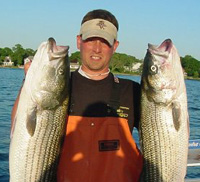
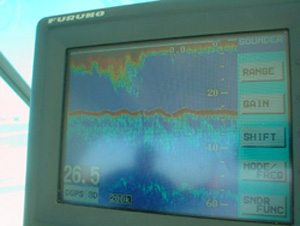 The schools typically swim close to the beaches, from tight to shore to between 30- and 60-foot depths. For whatever reasons, the fish swim in the shallows early in the mornings and then move deeper as the sun rises.
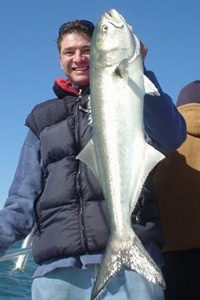 Again, blues and sometimes small stripers will swim toward the top, and bigger bass will hang toward the bottom. The bigger bass pick up the scraps of bait and injured baitfish that fall to the bottom, letting the other fish do the work of harassing the bait on top.
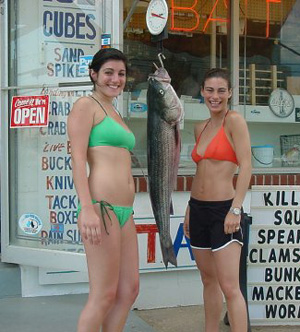 When Anthony is fishing personally, he’ll use the Shimano butterfly jigging system, the system of jigs, rods and reels built specifically for jigging, and finds the butterflies more effective than any other jigs. But they’re expensive, and one jig can cost as much as twenty-some dollars. Again, impractical on charters.