|
|

 |
 |
 |
 |
 |
 |
 |
 |
 |
| Mon., June 8, 2026 |
 |
| Moon Phase: Last Quarter |
|
Next Full: June 29 Next New: June 14 Sunrise: 5:26 a.m. Sunset: 8:24 p.m. |
| More Info |
| Tuna Bargain South Jersey's inshore bluefins: All the tuna fishing you could want, but at less cost and effort. By Mark Marquez II Posted 7/11/08 |
||
|
Good things come to those who wait. But sometimes good things come first. Bluefin tuna fishing has launched the local tuna season at the lumps, bumps and holes from 20 to 30 fathoms off South Jersey in the past two weeks. The fishing is close to shore, an advantage over the longer-range The bluefins at this time of year Just about nothing could be better with the fishery. Still, the fish are big, and even one will provide many meals, and the angling experience with these living freight trains is second to none. The relatively short sailing distance to catch them is something to consider. Bluefins start moving to waters off New Jersey along 20 to 30 fathoms, the inshore ocean, when water temps reach the high 60s, usually in late June. They can stick around off Jersey from June through August, but sometimes leave earlier, even by late July, if the ocean heats up too much. Last year they could be found in September. The fish are caught anywhere from 25 to 50 miles off Cape May. |
|
The inshore lumps, like the East Lump, 19-Fathom Lump and the Hambone, and holes, like Massey’s Canyon and the Elephant Trunk, are half the distance. When you’re up against the elements on a fishing boat, that’s a big difference in time, cost and energy. Bluefins at this time of year are trolled, chunked and jigged. Trolling tends to work early in the season, in June and early July, because the thermocline is higher in the waters, maybe 30 feet down. The fish hover above or below the thermocline, and will come up to attack a trolled lure.
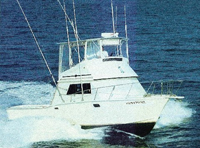
The Heavy Hitter arrives on the grounds for trolling just before dawn, when night is barely lingering. Through daybreak can be one of the better bites, like with any fishing. Five lines are usually trolled: two off the long riggers, one off the center rigger, one 100-feet deep, and one flatlined close to the boat and near the surface. Capt. George trolls the limited number of lines to avoid tangles or confusion when a fish hits, because the hook-up could be the only shot at a bluefin all day. Ballyhoos dressed with Ilanders are the typical baits. On chunking or jigging trips, the vessel is on the grounds by 4 a.m., leaving the dock at 2 a.m. The fish can hit on the chunk both in the dark and daylight. Four or five chunks of cut butterfish are tossed in the waters periodically for chum. A key is not to chunk too heavily, George said. When the tuna are in the slick, they’ll stay a long time. The boat’s charters usually fish with the butterfish or sardines on a fluorocarbon leader. They’ll usually begin fishing with 60-pound leaders. If no fish bite, they’ll drop down to 40. If the fish are deep or large, they might use 80. The baits will be placed at depths where the fish finder marks them. Again, the tuna will roam above or below the thermocline. Jigging is highly effective in the chunking slick. Many charters are reluctant to expend the energy to keep working the jigs, but George encourages them to. Sixty-pound line is used on 50-class reels for the bluefins. The standard recommendation for setting the drag is one-third of the line strength. That’s 20 pounds. But George goes lighter, setting the drag at 15 pounds, because he feels that the large amount of line in the waters exerts strain. George mostly decides where to fish based on reports about the best catches. He’ll look for bait readings on the fish finder on arrival, and that’s important, but bait often doesn’t show up on the screen until daylight.
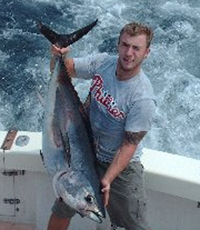
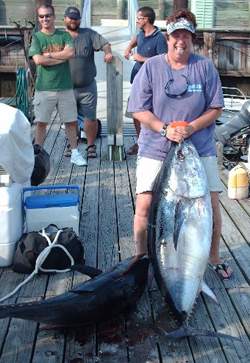
The bluefins can range from 25- or 30-inch footballs to 200-pounders. Fish 60, 70 and 80 pounds are common, and ones topping 100 pounds are not uncommon. The smallest tuna, like the footballs, seem more prevalent at the beginning of the season. The tuna move north to New England from New Jersey. They make the return trek south in fall. George believes two different size classes of bluefins migrate past Jersey. The bluefins in summer are one group. But he believes the other group is made up of larger bluefins, often topping 150 pounds, that anglers off New England battle in summer. The larger bluefins are never seen off New Jersey from spring through summer. But they had to pass to get to New England. George believes they swim past in March or April, following the spring migrations of mackerel and bluefish. Jersey anglers never fish the waters at that time of year, because the ocean is still wintry, uncomfortable and dangerous. In New England, the bluefins feed on mackerel and blues, another hint that they might follow the migrations of those fish past the Garden State. The summertime bluefins off Jersey are smaller, but no offshore angler scoffs at a chance to fight a 60- to 80-pounder. The back-breaking, skill-testing fight is a peak of sportfishing. Plus the price of sushi or a grilled tuna steak is evidence enough of the culinary value. All of that in half the distance of the usual tuna trip? What a bargain! |
||
 But once the ocean heats up, the thermocline drops to deeper depths, and the chunking bite, when chunks of bait are dropped to the depths, and therefore jigging, comes into its own.
 Weed lines are also a specific place to fish once on the grounds. Many anglers think of weeds as places to find mahi mahi, known to haunt the flotsam. But all fish, including bluefins, will be attracted to the baitfish and forage that gather around growth.