|
|

 |
 |
 |
 |
 |
 |
 |
 |
 |
| Mon., June 8, 2026 |
 |
| Moon Phase: Last Quarter |
|
Next Full: June 29 Next New: June 14 Sunrise: 5:26 a.m. Sunset: 8:24 p.m. |
| More Info |
| Tackle-Busting, Back-Breaking Colossus By Mark Marquez II Originally Posted 12/7/07 |
||
|
Sometimes the names of fish are subtle. Bluefish. Or brown trout. The color isn’t actually brown, but more like dabs and dots of different colors, creating the impression of brown. I get the feeling people who named Bluefish? Oh, I see. I get it. How about this one? Whoa. Hold on. That’s not subtle. That sounds like a tackle-busting, back-breaking colossus. And it is. Catching a giant bluefin
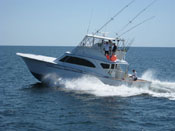
tuna is the Take the biggest rods and reels, The crew on the Low Profile, from the Over Under Adventures fleet, arrives in late November each year at Morehead City, N.C, to begin fishing for the tuna. A few boats began discovering the giants at wrecks off North Carolina in the early 1990s, Capt. Trey Rhyne, who oversees the company, said. Word spread, and now anglers December to the beginning of February are peak months to tackle these fish, averaging 300 to 400 pounds, pushing 700, in these waters. |
|
For the recreational angler, the fishing is usually catch and release.
“It’s unbelievably exciting when you get the bite,” Trey said. The giants often explode on the baits on the surface, and no better chance exists to practice the art of fighting big game. Landing these fish is a matter of the proper technique, the right tackle and a captain who can properly maneuver the boat, Trey said. Over Under fishes 80- or 130-class rods and reels, and charters use the fight chair. With the proper gear, technique and crew, the fish should be able to be reeled in and released within a half-hour to 1 ½ hours. Giants can be fought with stand-up tackle, but only the experienced should take on the danger. A spread of five horse ballyhoos are trolled, three toward the surface, and two on planers, as deep as they’ll go. Most of the baits are dressed with Ilanders or other skirts. The fishing is hit or miss, and the bluefins constantly relocate. They’re either there or they’re not, and they might turn up one day, disappear the next, then show up another two, and so on. The tuna hold in waters 3 to 20 miles offshore, relatively shallow. The crew is looking mainly for bait that attracts them, and waters in the 50s draw the forage, along a temperature break, structure or other typical factors. Waters from Cape Hatteras to Cape Fear are home to the bluefins during this time, and Morehead City is located roughly in the center. The giants normally bite best at daybreak, and one might be hooked, or even two, and then the fish has to be fought to the boat. That often occurs during the fishing's entire peak time, so anglers can expect to battle one bluefin, maybe two, if they’re lucky, in a morning, if the bite is “on.”
Multiple bites do happen, and maybe half the time two fish attack at once, and lots of fish will also be missed. North Carolina’s coastal weather can be troublesome, and 70-degree Where these tuna come from and disappear to the rest of the year is a question for the scientists, who are still trying to figure it out. Two different spawning stocks of Northern Atlantic bluefins are believed to exist, one from the Mediterranean Sea, and one from the Gulf of Mexico and the Straits of Florida. Scientists have tagged giants with tracking devices and watched the tracks span the entire distance from America to the Mediterranean or from the Gulf to Nova Scotia. Charts that plot an individual fish’s ocean-wide travels are a little stunning. The lives of these giants, tuna that can age up to 30 years, is mostly a mystery. Maybe that’s part of the fascination. But for anglers, it’s something more along the lines of knowing that a 1,500-pounder is the world record on a rod and reel. Nothing subtle about that. |
||
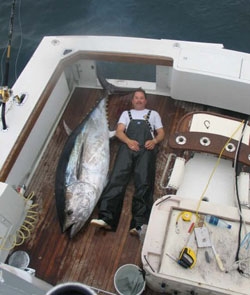 Recreational anglers come for the experience.
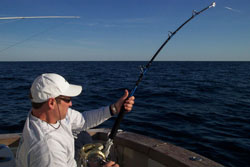 Charters--up to six people but ideally two to four, because six anglers are unlikely to catch a giant apiece on one trip--and