|
|

 |
 |
 |
 |
 |
 |
 |
 |
 |
| Mon., June 8, 2026 |
 |
| Moon Phase: Last Quarter |
|
Next Full: June 29 Next New: June 14 Sunrise: 5:26 a.m. Sunset: 8:24 p.m. |
| More Info |
The Prep, the Hours, the Dollars |
||
|
It can happen on any fishing trip. You’ve spent hours beforehand tying rigs, spooling reels, driving around buying supplies, prepping the boat, gathering food, clothing, aspirin, whatever. Finally you’re traveling to the coast to take the trip. Now you’re on the water. Everything’s prepared to a tee. There was no skimping for your day off. This can hardly be more disappointing than on an offshore trip. Capt. Freddy Gamboa from Andrea’s Toy Charters from Point Pleasant thought of the answer, if there is an answer. But many times there is a solution: The mixed-bag offshore trip. Why sit on the anchor for tuna all night when some unknown factor is putting off the bite? That’s the answer. Andrea’s Toy Charters usually follows While another boat is anchored on |
|
Many anglers will target tuna and only tuna. Maybe they’ll think about switching to another species only in desperation, when no tuna appear after a long time. |
||
At press time, the mid-shore season this year was mostly in the pits near Point Pleasant. Some bluefin tuna and mahi were being picked at places like the Chicken Canyon and the Glory Hole, but the reliability was in question.This fishing could change overnight, so keep in tune with the fishing reports. |
 |
|
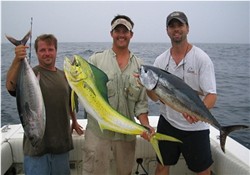
Tuna and a mahi mahi. |
||
| But for now canyon fishing will be the focus, because canyon fishing is the only real option. The canyon trips fish 60 miles or farther from shore and overnight. The anglers first troll for tuna in the afternoon, and then at nightfall set up to chunk for tuna, swordfish or sharks. In the morning the boat goes on the troll for tuna. When the sun rises high, deep-dropping for tiles is the plan. On the way home the boat hits the lobster pots for mahi mahi. |
||
Tuna trolling is pretty straight ahead. |
 |
|
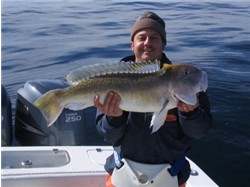
A tilefish. |
||
Fred prefers places with at least a combination of two of these factors, or he’ll move to the next spot. This is a typical spread, but one thing that Andrea’s Toy might do that’s different is to fish the lures on the starboard side in one color and the lures on the port side in a different color. The idea is simple: Certain colors might work better than others, depending on water clarity and visibility differences from waves. This allows the fish to choose the color, and once one color works, all the lures are switched to that color. Fred often starts with a green and yellow combo on one side and a black and purple combo on the other. These two combos contrast with each other, creating totally different silhouettes along the surface. Now the sun is setting, trolling is finished, and it’s time to chunk for tuna. Fred usually likes to chunk near the canyon wall edges or along the 100-fathom line on the continental shelf. Tuna will hold along edges, like any fish will. Again, chunking is fairly straight ahead. Once a likely spot to fish is reached, the boat is anchored on the edge. Chunks of bait like butterfish or peanut bunker are tossed in the water to attract tuna, and the anglers fish with the chunks or live bait. |
||
|
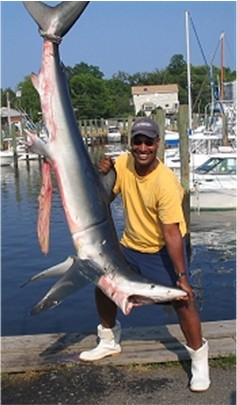
When tuna chunking is slow, most anglers wait it out. But Andrea’s Toy will instead go on the drift for swordfish and sharks and return to tuna chunking later in the night or early in the morning. Tuna might also be found on the fish finder while the boat is covering ground. The boat is set up to drift over structure. |
|
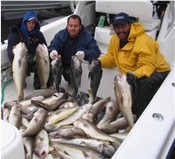
A mess of tiles. |
||
For swords, live squid caught on the trip will be used for bait. Three rods will be used to fish the baits at three different depths: one along the thermocline, one a hundred feet below the thermocline, and another a hundred above. If the thermocline is too deep, the baits are placed 100, 200 and 300 feet down. The baits are kept as straight down as possible, using 25 to 50 ounces of weight, depending on the current and drift. Chunking will be done to attract the fish. For sharks, the bait will be loins from fish in the box or heads of small fish. The bait is staggered and hung below floats 25, 50 and 75 feet down. The lines are placed 50, 80 and and120 feet away from the boat, and a chum bag is hung in the water to draw the predators. Andrea’s Toy will usually drift 3 to 5 hours and then return to anchoring for tuna before the bite turns on. In the morning, it’s back on the troll for tuna. When trolling drops off, or if it’s unproductive, the anglers deep drop for tilefish. Tilefish are impervious to water temps and clarity and the presence or absence of bait. To find them, use the fish finder to locate clay bottom in 400 to 600 feet along the canyon edge. On Fred’s machine clay bottom shows up smooth and a different color. The tiles like to burrow in the clay in “colonies.” Once the fish are found, keep drifting the same area. A top and bottom rig tipped with squid will do the trick. Next it’s off to the lobster pots on the way home for mahi mahi. The anglers might pitch soft plastic lures on light tackle along the pots, or they might troll along the pots with light tackle, or maybe both. When trolling, Fred does use a technique that can be an advantage. As the boat approaches a pot, the anglers are instructed to throw a handful of live killies to the structure. This gets the mahi up and feeding in time for the trolling spread to pass over them while they’re active, increasing the chances that they’ll hit the spread. |
||
By now, the anglers have been fishing a long time, a variety of dinner options should be iced down, mouths are yawning, eyes are being rubbed, and it’s time to head home. It’s been a lot of effort. The results? The skunk, the doughnut, El Zip-O -- they’re unlikely. All the work on the water was worthwhile, and so was the prep. One thing’s for sure. If it was a slow trip, which can happen with fishing, it wasn’t for lack of trying on the fishing grounds. The mixed-bag offshore trip. It’s tough to beat. |
 |
|