|
|

 |
 |
 |
 |
 |
 |
 |
 |
 |
| Mon., June 8, 2026 |
 |
| Moon Phase: Last Quarter |
|
Next Full: June 29 Next New: June 14 Sunrise: 5:26 a.m. Sunset: 8:24 p.m. |
| More Info |
September Options |
|
New Jersey’s saltwater-fishing season goes something like this. Winter flounder shake off the mud, rise up and start biting in the rivers and bays by March. Similar to the fish, anglers rise up and out of their houses, and begin moving around the waters to catch. The first large, migrating striped bass start appearing one day in April from the south, and fill local bays on the way to the rivers to spawn. |
|
Mackerel then school past the coast in late April, signaling a mass movement of species to In the meantime, winter flounder high-tail offshore to escape waters now crowded with other fish. Summer flounder or fluke swim in the opposite direction, pushing in from offshore to spend the warm months in the bays. |
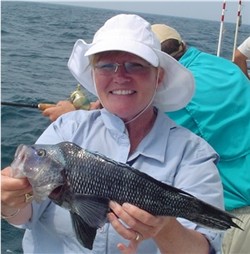 Sea bass fishing is one of the best September options. |
Fluke now have the run of the coast, lounging for months, like the anglers drifing lazily in boats to catch them, settled in for summer. Migrating stripers have traveled north to cooler waters, and blues have moved to deeper waters. Stripers are gone, and fluke season is ended. Oh no. September can almost be considered one of the slowest months for the state’s inshore saltwater fishing. Fluke fishing’s finished, and the return of stripers and blues on the fall migration is weeks away. What’s an angler to do in September? “Plenty,” says Capt. Chuck Graham from Angler Sportfishing Charters from Beach Haven. There’s no let up on his boat this month. The only difference is that the fishing turns into a mixed-bag effort, making the best of several options, depending on angler preference or what’s biting best at the moment. Fishing is no longer the no-brainer decision to target one species like fluke. Chuck is located roughly along the center of the state’s coast, and his fishing can be a fair representation of what’s available from north to south in Jersey. |
|
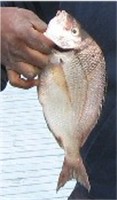 Many of the fish that will bite, including porgies, are delicious. |
Bottom fishing for porgies, sea bass and blackfish is one of the primary options, and a great one, Chuck says. The fish usually hold on the ocean reefs, wrecks and rocks during the month, and each one of them is one of the better tasting, local fish. Chuck will sail to the bottom structure, usually 7 or 8 miles offshore, and anchor up on a piece. Then his charters will drop down two-hooked, bottom-fishing rigs with clams, mussels or such bait, with chum lowered all the way down in a pot. |
Chuck prefers standard rigs like any of the typical ones that can be purchased for this type of fishing, and he favors Aberdeen or O’Shaughnessy hooks. The Aberdeens, thin-wired with a gradual curve and no offset, are his first choice. Lighter-gauge hooks are used for sea bass and porgies, and heavier hooks are tied on for blackfish, because sometimes the blacks will have to be wrestled out of the snags. Hooks from 1/0 to 3/0 can do the trick. The fishing is more about targeting known areas that carry the fish than anything else, in addition to heading out during the right season. The season is usually “on” in September, but fishing reports and networking with other anglers will confirm. The places to fish come from experience, networking and frankly fishing. The popular reefs and wrecks are the places to begin looking, and then the repertoire can be expanded. Chuck’s charters will use conventional rods and reels for 20- to 25-pound line, usually braided line for the best sensitivity. But this isn’t the end of the options. |
|
Tuna are another fine choice at this time of year. Chuck targets bluefin tuna 35 miles offshore, pretty much through fall, depending on the weather. September can offer many comfortable, safe days for sailing to the grounds. |
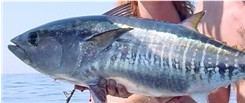 Tuna are no shabby option. |
His charters will troll for the bluefins with light rods, no more than 50-class, with something like Green Machines behind a bird and daisy chains. If he sees indications that enough of the tuna are around, he’ll cut the engines and start chunking for the fish on a drift. He’ll toss chunks of butterfish, peanut bunker or such bait in the waters to attract the bluefins, and slip a hook in a chunk and send it out. A fight like a drag-racer is one of the reasons for the fishing, but so are the tuna steaks. Trolling or chumming for bonito or false albacore is also a great opportunity this month. The fishing is done at places such as Barnegat Ridge, but on occasion the speedsters will hold at spots as close to shore as the surf during this time of year. This is “opportunity” fishing for Chuck--sometimes the fish are there; sometimes not. A captain such as him keeps informed through the grapevine, and he’ll know when and where the fish are available, if they’re available. Both fish are speed demons, and the bonito taste similar to tuna, though the albies certainly do not. Albies are poor-tasting and are usually fought for the sport and released, unless someone’s keeping them for strip baits. Bluefishing is also on tap, whether for big ones farther offshore at places such as Barnegat Ridge or smaller ones that hold closer to shore at this time of year. Striped bass fishing is in the doldrums around Beach Haven between the spring and fall migrations. Other areas, such as north toward Sandy Hook or in the back bays of South Jersey, hold populations of resident stripers all year long. But stripers are a moot point near Beach Haven until fall. So are weakfish. Although some areas in New Jersey, including Barnegat Bay, Raritan Bay and Delaware Bay, can put out plenty of weaks this month, the population of these fish has been slim near Beach Haven in recent years. Weaks along the coast can also start to stage near the shoreline in September in much of the state, having come out of the bays before migrating south. One might think that coastal fishing takes somewhat of a hiatus in the next weeks before the fall migration. But Chuck knows otherwise. He’s well aware of options, and great ones at this time of year. September options. |
|
