|
|
 |
 |
 |
 |
 |
 |
 |
 |
 |
| Mon., June 8, 2026 |
 |
| Moon Phase: Last Quarter |
|
Next Full: June 29 Next New: June 14 Sunrise: 5:26 a.m. Sunset: 8:24 p.m. |
| More Info |
page 2 of 2 |
|
| The Salmon River | |
Continued from previous page ... |
|
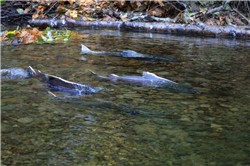 Finning Chinook salmon. Photo from U.S. Fish and Wildlife Service. |
Chinook salmon do not feed while they’re spawning, though cohos will tend to attack regardless, Dence said. But even though the fish aren’t feeding, they swat baits out of instinct, especially when they first enter the river. Anglers are trying to aggravate the fish to draw a bite, he said. |
When the salmon are on spawning beds, they sometimes attack a bait simply to remove it from the bed, he added. The lack of feeding contributes to the difficulty of the fishing. Catching the salmon can take quite a learning curve. Take my experience. On my first trip I fished an entire day from sunup to sundown without hooking anything but the rocks on the bottom. But the trial and error led me to begin hooking salmon by the middle of the next day. On that trip I learned I needed to fish the bait as close to the bottom as possible without snagging the boulders below. It was a fine line and took a lot of practice. But that’s not the only key. Another example is that I know someone who had been fishing the middle of the river, and then he hired a guide, who taught him to fish the shallows right up against the banks for success. But again, there are other factors, and it takes trial and error, and a guide can go a long ways toward helping you figure it out. The finer details of the fishing are learned on the river. But general knowledge is necessary to begin. Dence recommends a spinning outfit with an 8-1/2 or 9-foot rod. When the river flow is low, use 8- to 15-pound test. When it’s high, bump up the test.
For fly fishing, he recommends a 9- or 10-weight rod with a level or running line, but some prefer floating lines. Salmon egg patterns, Comets and naturals Split shots, sinking fly line tips and other methods are used to get the baits, lures and flies to the desired depth. As usual on moving water, casts are quartered across the flow, and the baits are swung downstream. But the nuances of this presentation are a key, and you’ll see experienced anglers hooking up often, and many others rarely catching a fish. Presentation isn’t the only challenge. Hooking the salmon is only half the battle, because landing them can be just as challenging. These big fish will head into the strong current when hooked, and hold on, because they’re not going to be reeled in anytime soon. You must learn to control the fish before it rockets too far downstream. One important factor is that you want to try to keep the salmon in the calmer water near the banks, and gain line. If the salmon makes it too far downstream, you’ll never be able to catch up, because of the trees, boulders, deep water and cliffs beside the banks, and the fish will break off. A net is a must, and experienced anglers can net the fish themselves. But on my first trip, one of the amazing aspects was that I literally had to yell to my netter when I thought it was time for him to try to net my hooked fish, because the fish had peeled off my line that far downstream. This also shows how dangerous the river can be. If you end up falling in the flow of the river, you’re in trouble, and you could drown.
Waders are also necessary, and so are warm clothes, because the weather can be chilly, and standing in the cold river all day can be uncomfortable. Korkers, or metal cleats for the soles of your waders, are also mandatory for walking along the river’s slippery rocks. Accomodations are cheap in the area compared with Jersey, and an online search, including on All Seasons’ web site, will turn up plenty of options. Don’t forget the prize: the salmon meat. Salmon is delicious, and plenty of places, including All Seasons, will clean and fillet the fish for only a few bucks. A number of locations, but not the shop, will also smoke the fish for a small fee. The taste is great. Other local rivers and tributaries, especially the Oswego and Black rivers, also hold salmon. The Salmon River and other local waters are also home to steelhead trout and big brown trout. These fish usually enter the Salmon River toward the end of October, and fishing for the browns is normally a short run mixed with the steelhead. The steelhead stay in the river during winter, spawn, spend a week or so feeding toward May and then drop back down to the lake, usually during the first week of May. No matter the reasons you prefer certain types of fishing, the Salmon River would seem to offer something to fulfill every angler's preferences, whether it’s the fight, the challenge, the beauty of the fishing or the tasty salmon. Surely you’ll want to make your own fall run to the river. |
|
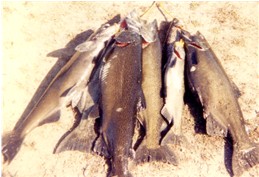 Spin fishers toss anything from natural salmon egg sacks to flies, single-hooked Mepps spinners and spoons like Krocodiles or Cleos.
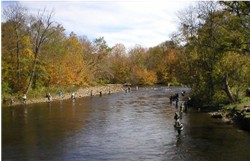 An inflatable life vest, the kind that you can pull a cord to inflate, is one piece of equipment that Dence recommends. He also suggests a wading staff and polarized sunglasses to help see the fish through the glare of the surface.
